If you're considering surgery, one of your first questions will likely be about the appearance of the scar. It's a very common concern. The answer depends on both your surgeon's technique and your own actions in the following months.
A surgical scar It's the collagen tissue the body produces to close an incision. It's not a failure of the procedure, nor is it something that will completely disappear, but its appearance can be greatly improved with proper care.
In this guide we explain how minimize scarring after plastic surgery, step by step and based on scientific evidence.
What is a surgical scar and what types exist?
Every incision heals in stages. First, the bleeding stops, then inflammation sets in, then the body builds new tissue, and finally, that tissue matures over several months. When that last phase becomes unbalanced and the body produces too much collagen, raised scars appear.
It is useful to distinguish between two types. hypertrophic scar It is thick and raised, but remains within the limits of the incision. keloid, However, it grows beyond the original wound. According to the American Academy of Dermatology, A hypertrophic scar appears one or two months after the injury, does not extend beyond its edges, and often fades over time, while a keloid does not disappear on its own. Recognizing which type you have determines the treatment.
| Guy | Aspect | Boundaries | When does it appear? | Evolution | First step |
| Normal | Flat, pink at first and paler over time | Inside the incision | Since the closure | It matures in 12 to 18 months | Basic care and sun protection |
| Hypertrophic | Raised, red, may itch | Inside the incision | 1 to 2 months later | It usually attenuates | Silicone and pressure |
| Keloid | Soaring, bright, it keeps growing | It goes beyond the incision | Months later | It doesn't disappear on its own. | Medical evaluation and intralesional corticosteroid |
What influences the way you heal?
Your scar depends on factors you don't control, such as genetics, age, body area, and skin tone, and on others you do control, such as smoking, nutrition, sun exposure, and physical exertion in the first few weeks.
If you have dark skin or a family history of keloids, tell your surgeon at the consultation. Keloids are more common in Black and Latino people than in people with lighter skin tones., and between 33% and 50% of those who develop a keloid have at least one relative with this type of scar (AADThis doesn't mean you're going to develop one. It means your prevention needs to start earlier.
Tobacco is the modifiable factor with the greatest impact. A systematic review with meta-analysis of 60 studies found that, in cosmetic surgery, smoking is associated with a 2.5 times greater risk of delayed healing (odds ratio). Quitting smoking weeks in advance is one of the decisions that best protects your outcome.
How to minimize scarring after plastic surgery?
Each phase of recovery requires different care. Always follow your surgeon's instructions, as they vary depending on the procedure.
Before surgery
- Quit smoking with the advance notice they tell you. At New Body, before an abdominoplasty, we ask you to stop using it for at least 4 weeks. This reduces the risk of delayed healing.
- Boost your diet with protein: The skin needs that material to repair the incision.
- Report your background of keloids or difficult scarring. This way your surgeon plans the incision and prevention from the start.
Weeks 1 and 2
- Keep the incision clean and dry According to the treatment instructions. An uninfected wound heals better and leaves a finer scar.
- Use the compression garment the indicated time. It reduces inflammation and tension on the wound.
- Do not scratch or pick at scabs, Even if it stings. This way you avoid reopening the wound.
Weeks 3 to 8
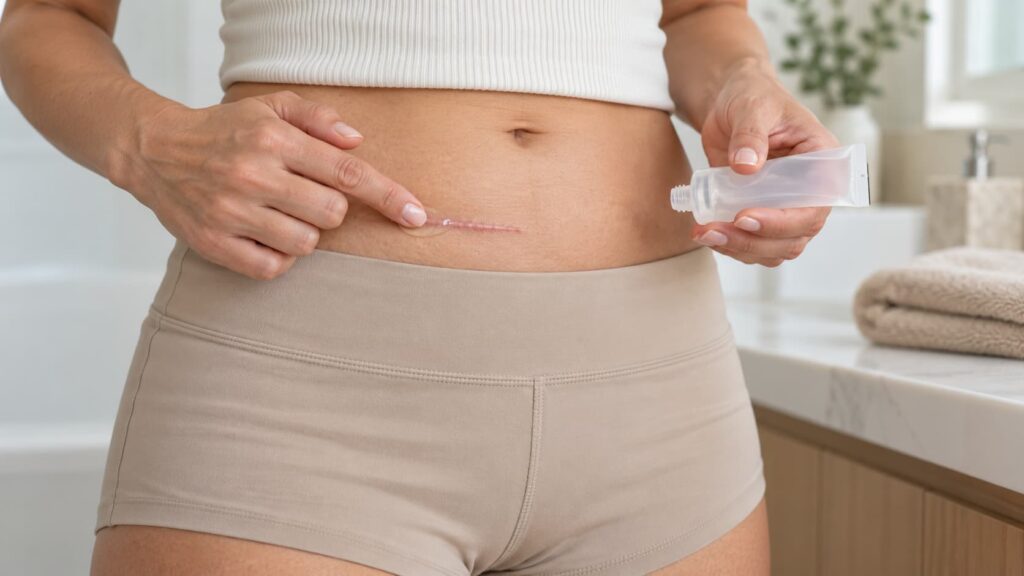
- Start with gel or silicone sheets only when the wound is completely closed and your surgeon authorizes it.
- Avoid lifting heavy objects and making sudden stretches. Tension widens the scar while the collagen is still fragile.
Months 3 to 12
- Protect the scar from the sun Use SPF 30 or higher, or cover it with clothing. In Miami, the sun is intense year-round, and a newly exposed scar can darken permanently.
- Massage the area If your surgeon recommends it. It helps soften the tissue.
- Be patient with the ripening process. Evaluating the outcome prematurely leads to unnecessary treatments.
Silicone, creams and lasers: which treatment has scientific backing
Silicone gels and patches are the most supported option for preventing raised scars. International clinical guidelines on scar management give a primary role to silicone gel sheets and intralesional corticosteroids, concluding that these are the only treatments with sufficient evidence for evidence-based recommendations; other commonly used therapies are accepted as standard practice. Creams with vitamin E or oils moisturize the skin, but they do not have the same level of evidence.
| Treatment | When to use | What scar | Scientific support | Who says so? |
| Silicone gel or patches | With the wound closed | Prevention and hypertrophic scarring | High | Surgeon |
| Creams with vitamin E or oils | After the closure | General hydration | Limited | Surgeon |
| Massage | As indicated | Firm scars | Standard practice | Surgeon or physiotherapist |
| Laser | After several months | Redness, pigment, texture | Standard practice | Specialist |
| Intralesional corticosteroid | If the scar rises | Hypertrophic and keloid | High | Doctor |
| Surgical revision | After ripening | Wide or retracted scars | Depending on the case | Plastic surgeon |
Scars after bariatric surgery: why they require their own plan
After significant weight loss, scars require more care because incisions are longer and the skin has fewer reserves. A abdominoplasty after bariatric surgery, An arm or thigh lift involves extensive incisions.
A review published in Nutrients It points out that body contouring in these patients should consider "induced malnutrition," which can affect recovery, scar quality, and the complication rate. Smoking has an even greater impact in this group: in bariatric surgery sequelae, the meta-analysis cited above found an odds ratio of 3.3 for delayed wound healing and 3.1 for skin necrosis.
At New Body Surgery Miami, the dual specialization in bariatric surgery And plastic surgery allows you to check your nutritional status before body contouring, with both teams coordinated in the same clinic.
Read more:
👉 Gastric sleeve scars: size, location, and care
Signs that you should consult your surgeon
Contact your medical team if you notice:
- A scar that grows beyond the incision
- Redness that increases after the third month
- Intense pain or itching that does not subside
- Discharge, foul odor, or wound opening
- Fever during recovery
Before trying any product on your own, consult a doctor first. Detecting a keloid early changes the prognosis.
How New Body Surgery Miami cares for your scars from the planning stage
At New Body Surgery Miami, scar care begins in the consultation, not after surgery.
He Dr. Ahmed Abdullah He is certified by the American Board of Plastic Surgery, is a member of the ASPS and ASAPS, and has published research on wound healing and growth factors. Over 20 years of experience, over 6,000 procedures and over 16,000 hours in the operating room.
That experience translates into concrete decisions:
- Planned incisions: In abdominoplasty, the incision is located below the bikini line, so it is hidden by underwear or a swimsuit.
- Tracking in Spanish and English: Each care instruction is explained in your language. Our Abdominoplasty recovery guide This protocol is shown week by week.
- Dual specialization in plastic and bariatric surgery: It is an advantage for patients with significant weight loss.
- Verifiable track record: The clinic was founded in 2004 in Kendall and has a 5.0 rating based on 49 reviews.
The first consultation is free and there are financing options. Schedule your evaluation and discuss your case and your scar with our team.
New Body Surgery Miami
Ready to take the next step?
Schedule your consultation and find out if you're a candidate. No obligation — just an honest conversation about your situation.
Contact us todayFrequently Asked Questions
The wound usually closes in two to three weeks, but the scar matures over 12 to 18 months. During that time, it changes color, texture, and thickness.
When the wound is completely closed, with no scabs or open stitches. This often happens from the third or fourth week onwards, always with your surgeon's approval.
Yes, once your surgeon approves. For the first year, keep the scar covered or use sunscreen with SPF 30 or higher.
No. All surgery leaves a scar. The goal is for it to be thin, flat, and discreet, and in many cases, it's hidden under clothing.
Yes. Depending on the type of scar, options include silicone, laser, corticosteroids, or surgical revision.