The breast augmentation recovery This is the period when your body heals the incisions and the tissues adapt to the breast implants. It's not the same process for all patients, and it doesn't end when the pain disappears: the final shape of your breasts is revealed gradually over the following months.
If you're considering surgery, or already have a surgery date, it's normal to wonder how long it will take, when you can return to work, or why your breasts look so high at first. Here, we answer those questions week by week, with information backed by medical sources and the experience of our team at New Body Surgery Miami.
What is breast augmentation recovery and how long does it last?
The recovery follows a breast augmentation, Breast augmentation is the surgery that places silicone gel or saline implants to add volume and projection to the breasts. It's not the same as a breast lift (mastopexy), which raises the tissue without necessarily adding volume. It's also not the same as fat transfer, a different technique with a different recovery process. If you're still deciding between options, you can read our guide on breast augmentation. implants or own fat to augment breasts.
The most intense phase is short, but full recovery takes months. According to the American Society of Plastic Surgeons (ASPS), After a postoperative period of 24 to 48 hours and a few more days of reduced activity, you will likely experience tenderness and swelling for several weeks. Therefore, it's helpful to think of recovery on two levels: functional recovery, which allows you to return to your routine in a few weeks, and the aesthetic restoration, which continues to progress until six months.
This is a path that thousands of women take every year. In 2025, breast augmentation and implant revision procedures totaled 304,234 in the United States, an 11% increase, according to the ASPS statistics report. Knowing what to expect at each stage helps you experience the process calmly and recognize any unusual signs in time.
Breast augmentation recovery week by week
The timelines below describe a typical, uncomplicated recovery. Your surgeon will adjust each recommendation based on your technique, the type of implant, and your progress at each follow-up appointment.
| Period | How do you feel? | What can you do? | What to avoid |
|---|---|---|---|
| 24 to 72 hours | Tiredness, chest pressure, discomfort | Walking at home, resting semi-upright | Raise your arms above your shoulders, handle |
| Week 1 | Swelling at its peak, breasts high and firm | Short walks, simple personal tasks | Carrying heavy objects, showering without authorization |
| Week 2 | Less pain, more energy | Office work, longer walks | Exercise, sleeping on your side or stomach |
| Weeks 3 and 4 | Almost complete autonomy | Light household chores | Carrying children or heavy bags |
| Weeks 5 to 8 | Minimal discomfort | Progressive exercise with authorization | Chest exercises without approval |
| Months 3 to 6 | Softer, more natural breasts | Complete routine | Direct sun exposure on the scar |
These are approximate timeframes for an uncomplicated recovery. Your surgeon will adjust each recommendation based on your technique and your individual progress.
First 24 to 72 hours
When you wake up from anesthesia, it's normal to feel drowsy, with mild nausea and a feeling of pressure or tightness in your chest, as if you had done an intense workout. The discomfort is usually strongest in these first few days and they are controlled with the medication prescribed by your surgeon.
Even if the body asks for rest, Walking at home from day one promotes circulation and reduces the risk of blood clots. Rest with your back slightly elevated, keep water and medication handy, and make sure someone stays with you for at least the first night.
Week 1
During the first week, swelling reaches its peak and your breasts may look high, firm, and even somewhat different from each other. This is part of the process and does not reflect the final result. You will wear the post-surgical bra continuously, except when your surgeon authorizes its removal for showering.
At this stage, you usually have your first follow-up appointment, where the incisions are checked and it's confirmed that the healing is progressing as expected. Often, by the end of the week, the pain has already decreased significantly.
Week 2
Many patients describe the second week as a turning point: More energy, less pain, and greater freedom of movement. In most cases it is possible to return to an office job, as long as it does not require lifting heavy objects or repetitive arm movements.
It's still not the time to exercise or sleep on your side. Nipple sensitivity can vary from tingling and burning to numbness, a common response while the nerves recover.
Weeks 3 and 4
Between the third and fourth week, you regain almost all your independence for daily life. You can do light housework and walk longer distances, but It's still advisable to avoid lifting heavy objects, carrying your children, or pushing and pulling forcefully., because the tissues around the implant continue to heal.
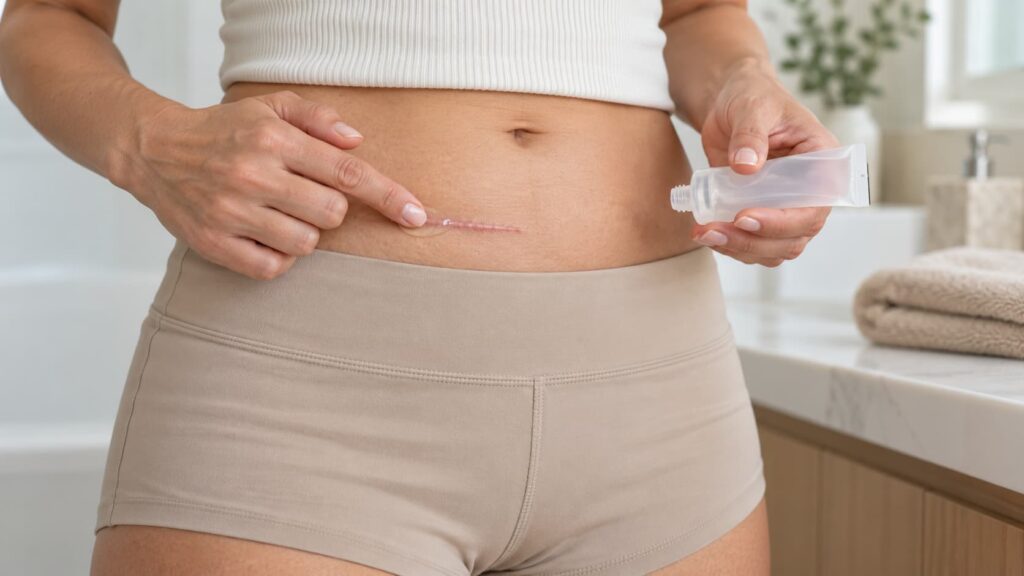
The scars appear pink or slightly raised, which is normal at this stage. If your surgeon approves, this is usually the time to begin scar care with silicone products.
Weeks 5 to 8
With your surgeon's approval, exercise is gradually resumed: first gentle cardio, such as stationary cycling or brisk walking, and then leg exercises. Exercises that involve the chest, such as push-ups or bench presses, usually wait longer. and should only be resumed when your surgeon confirms it.
Towards the end of this period, many patients switch from a post-surgical bra to a supportive, underwire-free sports bra.
Months 3 to 6
At this stage the implants finish settling, the residual swelling disappears and Your breasts take on a softer, more natural shape. This is the point at which the result can be assessed most accurately. Scars continue to mature and lighten during the first year, especially if you protect them from the sun.
When do implants settle and how does the shape of your breasts change?
It's normal for implants to look high at first and gradually lower during the first few months. After surgery, the skin and muscles of the chest are tight and swollen, pushing the implant upward. As the swelling subsides and the tissues relax, the implant descends and settles into the lower part of the breast, giving it a more rounded and natural shape.
This process is usually more visible when the implant is placed under the muscle, because the pectoral muscle needs more time to adapt. In most of our patients, the most noticeable change occurs between the first and third month, and the shape fully stabilizes around six months.
It is also common for one breast to drop before the other. No body is perfectly symmetrical, and each side may settle at its own pace. What is not normal is a sudden change: if a breast suddenly increases in size, hardens, or changes shape noticeably, consult your surgeon without waiting for your next appointment.
What factors change your recovery time
Recovery time depends mainly on where the implant is placed, whether the surgery is combined with other procedures, and your health status. That's why two friends who have surgery in the same month can have different experiences.
| Implant plan | Initial discomfort | Arm restraint | Considerations |
| Subglandular (over the muscle) | Minor | Shorter | Faster recovery; requires good tissue coverage |
| Subfascial (beneath the muscle fascia) | Minor to moderate | Brief | It combines comfort with greater coverage |
| Submuscular (under the muscle) | Elderly | More prolonged | Greater coverage; the implant takes longer to settle |
| Dual plane | Moderate | Moderate | Balance between coverage and natural form |
The technique also influences the risk of long-term complications. A systematic review that included 3,743 patients with subfascial augmentation found capsular contracture in only 1.01% of cases (PMCThe choice of plane doesn't depend on which one heals faster, but rather on your anatomy, the quality of your tissues, and the result you're looking for. That decision is made during a consultation.
Other factors that influence your recovery:
- Combined surgeries: an increase with a lift or a Mommy Makeover This involves more areas of healing and, therefore, more rest time.
- Type of work: An office job allows you to return to work sooner than a physical job, one involving caring for people, or one with repetitive arm movements.
- Tobacco: Smoking reduces tissue oxygenation and delays healing.
- Significant weight loss: if you had surgery bariatric surgery, Your body may have fewer reserves of protein, iron, and vitamins for healing, and your skin may have less elasticity. These patients need a prior nutritional assessment and often require a combined augmentation and lifting procedure.
Post-breast augmentation care: what to do and what to avoid
Following your surgeon's instructions is the most important factor in a smooth recovery. These are the most common care recommendations, with the reason behind each one:
- Use the post-surgical bra Day and night for the indicated time. It holds the implants in position and reduces swelling.
- Sleeps on his back and semi-upright During the first few weeks, this helps avoid putting pressure on the implants and allows any swelling to drain. A wedge pillow or several pillows can make the position easier.
- Walk from day one, ...in short, frequent walks. Maintaining circulation reduces the risk of thrombosis.
- Keep the incisions clean and dry Until your surgeon gives you the go-ahead to shower. Avoid bathtubs, swimming pools, and the sea until your wounds are completely closed.
- Protect the scar from the Miami sun. UV radiation can permanently darken the scar; cover it and use sunscreen when it's closed.
- Do not smoke or use nicotine products. Avoiding tobacco and limiting alcohol is widely recommended, because both can interfere with healing.
- Don't lift heavy objects or carry your children. in the first few weeks. Breast exertion can displace the implant or cause bleeding.
- Do not self-medicate. Some over-the-counter pain relievers increase the risk of bleeding; only take what is prescribed.
- Only perform massages if instructed by your surgeon. Not all implants or techniques require them.
When to return to work, driving, exercising, and traveling
The return to routine is gradual and depends on both the calendar and how you feel. These timeframes are guidelines; your surgeon will give you specific dates depending on your case.
| Activity | Frequent term | Condition for resuming it |
| Office work | 1 to 2 weeks | No pain when sitting and moving, no sedative medication |
| Physical work | 4 to 6 weeks | Authorization from your surgeon |
| Drive | 1 to 2 weeks | Without drowsy painkillers; being able to turn the steering wheel and brake without pain |
| Gentle cardio | 2 to 4 weeks | No impact or rebound |
| Gym and chest exercises | 6 to 8 weeks or more | Express authorization from your surgeon |
| Swim | When the incisions are closed | Confirmation in consultation |
| Air travel | According to your progress and your surgeon's instructions | Having passed the first review |
| Intimate relationships | 2 to 4 weeks | Avoid pressure on the breasts |
Regarding travel: many of our patients come to Miami from other states, the Caribbean, or Latin America. If this is your case, Plan to stay close to the clinic until your first check-up And consult with your surgeon about when it's safe to take a long flight. During the trip, get up and walk around, stay hydrated, and wear comfortable clothing with a front opening.
Normal signs and warning signs after surgery
Knowing how to distinguish what is normal from what is worrying gives you peace of mind and allows you to act in time.
| Which is normal | Call your surgeon if… | Go to the emergency room if… |
| Swelling that gradually decreases | One breast suddenly swells up or much more than the other | You're short of breath |
| Minor bruising | There is redness, warmth, or drainage at the incision site. | You feel chest pain |
| High and firm breasts at first | You have a high or persistent fever. | Note irregular or very rapid heartbeats |
| Tingling or changes in sensation | The pain increases instead of improving | One leg swells and hurts |
| One side settles before the other | A breast hardens or changes shape over time |
The ASPS indicates Seek immediate medical attention if you experience breathing problems, chest pain, or unusual heartbeats.
What is capsular contracture?
The capsular contracture This occurs when the capsule of tissue that the body naturally forms around the implant thickens and contracts, hardening the breast and potentially causing pain or deforming its shape. It should not be confused with the normal firmness of the first few weeks, which disappears as swelling subsides. It is the most studied complication of breast augmentation: individual studies report an incidence between 2.8% and 20.4%, and a systematic review calculated a combined rate of 3.6%.PMCFollow-up checkups allow for early detection.
Attention: This information is for guidance only and is intended for people planning breast augmentation or who have already undergone the procedure. It does not replace the instructions of your surgeon. As with any surgery, breast augmentation involves risks, including hematoma, seroma, infection, capsular contracture, changes in sensation, and thrombosis. If you have any questions about your recovery, please contact your medical team.
Emotional recovery also matters
The first few days can bring mixed emotions. Tiredness, the effects of the anesthesia, and seeing your breasts raised, swollen, or bruised can raise doubts like, "Did I do the right thing?" or "What if I don't like the result?". It is a common reaction and usually passes as the body recovers and the shape becomes natural.
Some helpful ideas:
- Avoid comparing yourself to photos of other patients in stages different from yours.
- Don't judge the result before three months have passed.
- Lean on your close network And give yourself permission to rest without guilt.
- Ask anything you need to know to your medical team.
If sadness or anxiety persists beyond the first few weeks, discuss it with your surgeon or a mental health professional.
Checklist to prepare your recovery before surgery
A good one breast augmentation recovery Start before entering the operating room. Review this list in advance:
Your preparation checklist
Mark each point as you get it ready.
Your breast augmentation recovery at New Body Surgery Miami
A smooth recovery depends not only on what happens in the operating room, but also on the support before and after surgery. New Body Surgery Miami is a plastic and bariatric surgery clinic located in Kendall, Miami, serving Hispanic and American patients in Spanish and English since 2004.
Our procedures breast augmentation in Miami are in charge of Dr. Ahmed Abdullah, Board Certified Plastic Surgeon, with more than 20 years of experience, more than 6,000 procedures performed and more than 16,000 hours in the operating room. This trajectory translates into individual planning of the implant, the plane and the technique, designed from day one for your anatomy and for a safe recovery.
What makes us different during your recovery:
- Bilingual % Support: You get your post-operative questions answered in your own language, without intermediaries or misunderstandings.
- Double specialization in plastic and bariatric surgery: If you've lost a significant amount of weight, we assess your nutritional status and skin quality before surgery. It's an approach that few clinics in Miami offer.
- Scheduled follow-up reviews to monitor healing, implant settling, and detect any changes in time.
- Transparent pricing, so you can plan your surgery and recovery without surprises.
- Rated 5.0 based on 49 reviews of patients who went through this process with us.
If you're considering breast augmentation and want to know what your recovery would be like based on your body and goals, schedule a consultation with our team.
New Body Surgery Miami
Ready to take the next step?
Schedule your consultation and find out if you're a candidate. No obligation — just an honest conversation about your situation.
Contact us today