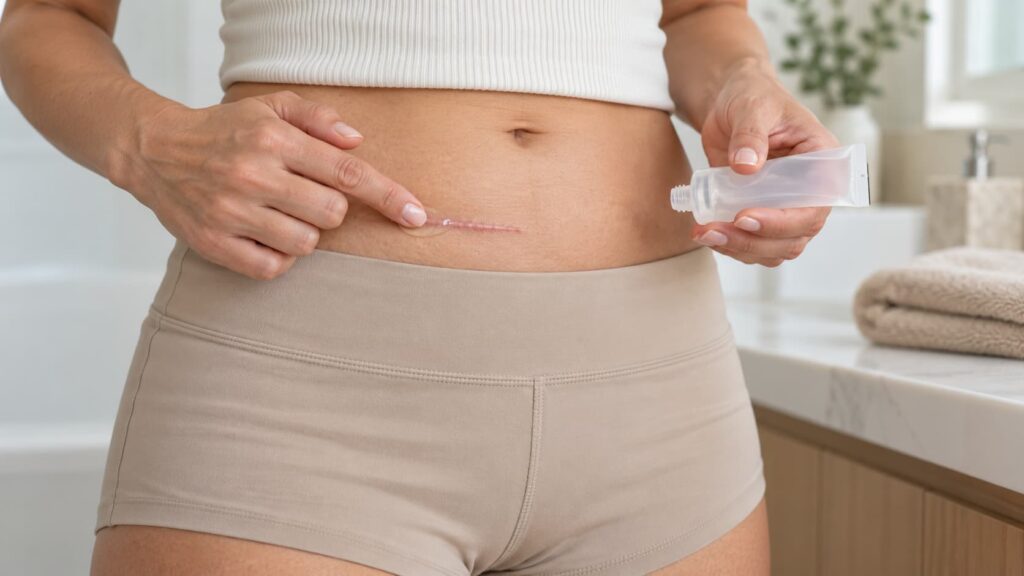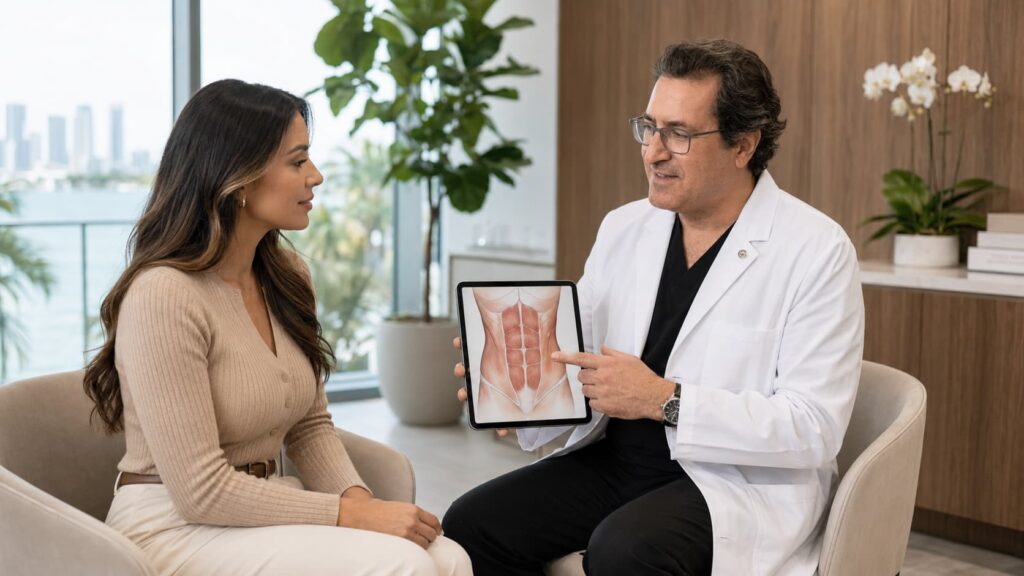
Have you tried diets, exercise, and waist trainers, and your abdomen still looks bulging as if you were pregnant? It's not a lack of discipline. In most cases, it's a structural problem: the separation of the abdominal muscles.
The abdominoplasty with diastasis It is the procedure that repairs that musculature from the inside, while removing excess skin and defining the silhouette.
Here we explain how it works, who is eligible, and what to expect from the process.
What is diastasis recti?
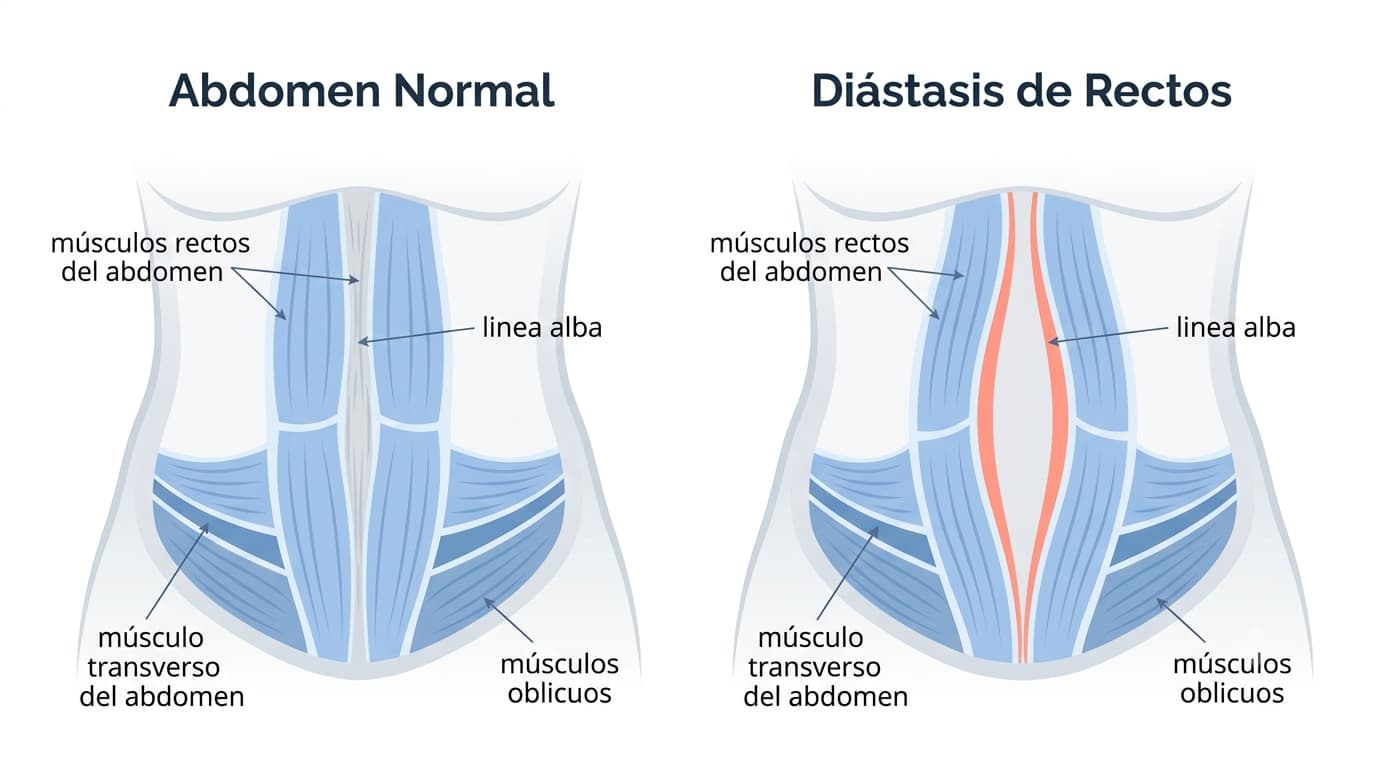
Diastasis recti It is the separation of the two muscles that run vertically down the center of the abdomen, usually joined by a band of tissue called the linea alba.
It is not a hernia or a disease; it is a weakening of the connective tissue that generates a bulge in the center of the abdomen, more visible when contracting the abdomen.
It can affect both women and men, although it is common after pregnancy.
Causes and symptoms: from pregnancy to bariatric surgery
Pregnancy is the most well-known cause, as the growing uterus stretches the abdominal wall to its limit. According to Cleveland Clinic, This condition affects 6 out of 10 women after childbirth, and a cohort study published in PMC found that It persists in between 32 and 46 postpartum women. That's why many women, even years after giving birth, continue to notice the lump.
But pregnancy is not the only cause. Large weight fluctuations, genetics and, increasingly, significant weight loss after a bariatric surgery They also stretch and weaken these muscles. In these cases, The skin and muscle become loose in a similar way to what happens postpartum., This makes surgical repair equally relevant for patients who have undergone a major weight loss process.
The most common symptoms are persistent bulging, loss of core strength, and lower back pain. A study in PMC found that the Women with diastasis recti have almost 1.8 times the risk of suffering from pelvic floor dysfunction., such as urinary incontinence, compared to those who do not have it.
Why does abdominoplasty correct diastasis recti?
When the separation exceeds 2.5 to 3 centimeters, neither exercise nor physiotherapy can close it completely, because the connective tissue has already lost its ability to retract.
The abdominoplasty This is corrected using a technique called plication of the rectus musclesThe surgeon sutures the inner edges of both muscles along the midline, like an internal corset, restoring the natural tension of the abdominal wall. Then, excess skin and fat are removed, and the navel is repositioned.
Abdominoplasty vs. other alternatives
| Option | When does it work? | Main limitation |
| Hypopressive exercises and physiotherapy | Mild diastasis, less than 2 cm, without excess skin | It does not close severe separations or remove excess skin. |
| Compression belts | As temporary or post-operative support | It does not repair the muscle on its own. |
| Abdominoplasty with diastasis | Separation greater than 2.5-3 cm, with or without excess skin | It requires surgery and a recovery period |
Are you the ideal candidate?
Not everyone with a protruding belly needs surgery; this list helps you identify if your case corresponds to the profile that benefits most from abdominoplasty with diastasis recti.
- Your muscle separation exceeds 2.5-3 cm and did not improve after months of targeted physiotherapy.
- You have completed your family or you are not planning a future pregnancy, as a new pregnancy may again strain the repair.
- You maintain a stable weight, with or without excess skin located in the abdomen.
- You are experiencing functional symptoms such as lower back pain, core weakness, or associated digestive discomfort.
- You're coming from a weight loss process (including bariatric surgery) and you are looking to reshape the abdominal wall.
Step-by-step recovery
Each body responds differently, but this is the general picture of what is usually expected after surgery, week by week.
- Week 1-2: relative rest, constant use of a compression belt, and movement with the torso slightly inclined.
- Week 3-4: Inflammation decreases; light daily activities are often resumed.
- Week 5-6: Low-impact exercise may be authorized, depending on the progress of each patient.
- Month 3 onwards: The scar continues to lighten and the final results of the plication stabilize.
Read also:
👉 Tummy Tuck Recovery in Miami: A Complete Guide
Why choose New Body Surgery Miami?
In New Body Surgery Miami Abdominoplasty with diastasis recti is performed by Dr. Ahmed Abdullah, Certified plastic surgeon with over 20 years of experience, over 6,000 procedures and over 16,000 hours of operating room experience.
This trajectory translates into a refined technical handling of the plication, a point that demands precision to achieve lasting results.
What distinguishes the clinic is not only the surgical experience, but also how the patient is supported: complete care bilingual in Spanish and English, transparent pricing from the first date and a Free initial consultation to evaluate your case without pressure.
Furthermore, as a clinic with dual specialization in plastic and bariatric surgery, we understand firsthand what the body undergoes after significant weight loss, something that few clinics specializing solely in cosmetic surgery handle with the same depth.
New Body Surgery Miami
Ready to take the next step?
Schedule your consultation and find out if you're a candidate. No obligation — just an honest conversation about your situation.
Contact us today